
Why blood sugar rises, falls, and shifts during endurance workouts. For diabetics and non-diabetics alike.
Most coaches, when they think about blood sugar during exercise, imagine a steady line.
If things are managed well, the thinking goes, glucose should stay relatively flat. Maybe a small shift here or there, but generally stable. That expectation shows up in conversations with diabetic athletes all the time.
The problem is that endurance physiology doesn’t really work that way.
Exercise changes how the body produces, releases, and uses glucose. Muscles start pulling fuel from the bloodstream. Hormones adjust. The liver releases stored glucose. Intensity changes the equation again.
When you combine all of that, the result usually isn’t a straight line.
It’s movement.
Before we talk about why that happens, it helps to look at what glucose tends to do when exercise is not involved.
When Nothing Is Happening
During a normal stretch of time without training, glucose can be remarkably stable.
You might see a small drift. Maybe a gentle rise or fall. But overall the line tends to behave.
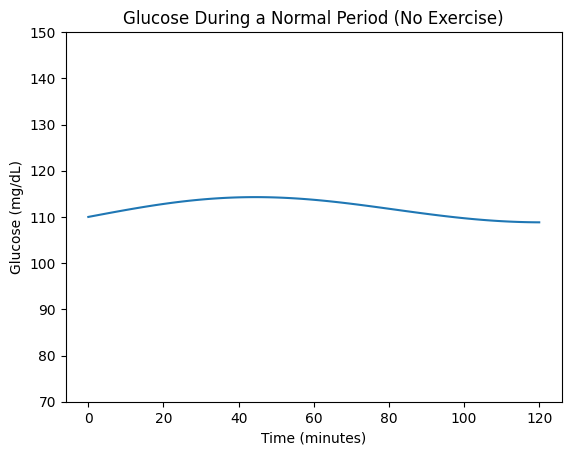
This is what many people expect to see all the time.
The body is relatively calm. Energy demand is predictable. Hormones are stable. The system hums along without much disruption.
Now let’s introduce endurance training.
What Happens Around a Run
Once you add a run into the equation, several things begin happening at the same time.
(Insert second graph here)
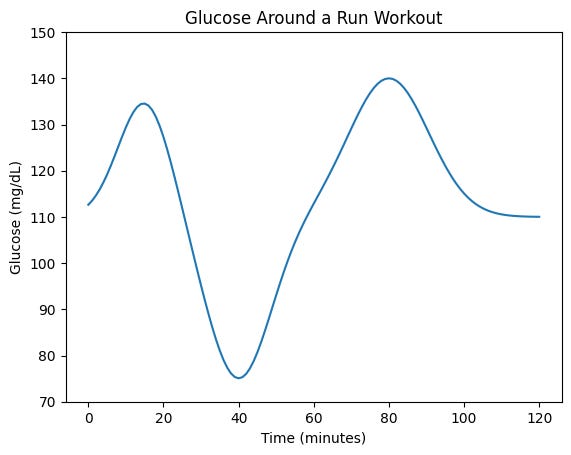
Before the workout even begins, glucose can move.
Many diabetic athletes take in carbohydrates before heading out the door. The goal is simple. Avoid starting a workout already trending low. Depending on timing and insulin, that fuel can push glucose upward before the first step of the run even happens.
To someone casually looking at the graph later, it might look like poor control.
In reality, it may be intentional preparation.
Once the run begins, the equation changes again.
Working muscles pull glucose out of circulation to use as fuel. If the session starts with a little intensity, or ramps up quickly, glucose can fall faster than expected. Even when the starting number looked perfect.
That drop isn’t necessarily a mistake.
It’s physiology.
The muscles opened the door and started pulling energy inside.
Then there’s the part that confuses people the most.
You finish the run. You haven’t eaten your recovery meal yet. And suddenly glucose starts climbing.
Exercise stress triggers hormone responses that can push glucose upward. The liver releases stored glucose into the bloodstream. The body is essentially making sure energy is available after the effort.
So the graph rises again.
If someone expects glucose to stay within a tight band the entire time, the pattern looks chaotic.
If you understand what endurance training does to the body, it looks fairly normal.
This is true for diabetic and non-diabetic athletes alike. The difference is that diabetic athletes have to pay much closer attention to the consequences of that movement.
A sharp drop is not just an interesting data point.
It can become dangerous quickly.
Low blood sugar is not something you casually shrug off and jog through. It can end the workout, wreck the rest of the day, and in serious cases become life-threatening.
That’s why training with diabetes requires more than fitness. It requires awareness, preparation, and a willingness to adjust before a normal shift becomes a real problem.
That’s also why I don’t head out for a run expecting a perfectly behaved line.
I expect the terrain to change.
My Garmin is paired with my CGM and I named it Judge Judy. If you’ve been reading here for a while, you’ve met her before. She’s the one delivering the verdict on my pacing decisions and glucose trends at the same time.
I watch the trend like it’s a live court case.
Evidence first. Decisions second.
And I always carry a couple extra gels.
Not because something will definitely go wrong.
But because sometimes it does.
The Real Skill
Endurance training puts stress on the body. Stress moves glucose.
That’s true whether you have diabetes or not. The difference is that athletes with diabetes have to pay closer attention to the consequences of that movement.
The goal isn’t a perfectly flat line. Endurance training rarely produces one.
The goal is understanding the pattern. Knowing why glucose rises before a workout, why it can drop when intensity starts, and why it sometimes climbs again after the effort is over.
When you understand those shifts, the graph stops looking chaotic.
It starts looking predictable.
And once it becomes predictable, it becomes manageable.
For diabetic endurance athletes, that’s the real skill.
Not forcing perfect glucose.
Learning how to train well while the numbers move.
Leave a Reply